After the Split: What the Bookshelf Knows That You Cannot Yet Say
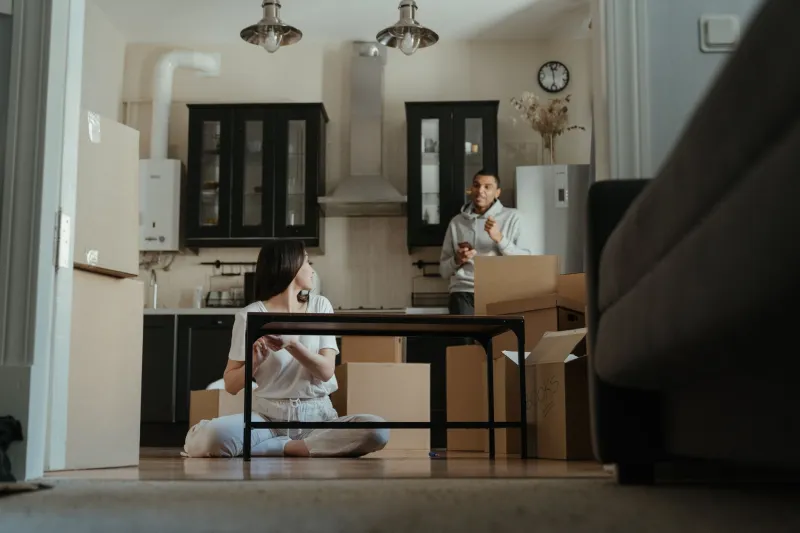
There is a particular cruelty in the fact that furniture does not know it has been abandoned.
The bookshelf you assembled together on a Sunday afternoon in October—the one where the instructions were wrong and you laughed until your sides ached—continues to hold its weight without ceremony. It does not register the departure. It does not flinch when you walk past it at two in the morning, unable to sleep, running your fingers along the edge of a shelf that once felt like proof of something permanent. It simply stands there, useful and indifferent, asking nothing of you except that you decide what to do with it.
This is the part of heartbreak that nobody prepares you for: not the absence of the person, but the overwhelming, suffocating presence of the objects they leave behind.
The Architecture of a Shared Life
When two people build a life together in America—whether in a studio apartment in Chicago, a rented house in Atlanta, or a condo in Portland—they do not merely share space. They construct an environment that encodes the relationship itself. The furniture they choose together, the art they hang on walls they don't own, the kitchen table where they negotiated everything from dinner plans to the future—all of it becomes a kind of physical grammar for the intimacy they share.
Psychologists who study material culture have long understood that objects carry what they call autobiographical resonance: a capacity to anchor personal narratives in ways that photographs and text cannot quite replicate. A chair is not merely a chair when it is the chair where someone read to you, or the chair you dragged to the window during a snowstorm because the light was better there. It becomes a node in the story of who you were when you were with that person.
This is precisely what makes the dissolution of a shared home so disorienting. The relationship ends. The person leaves. But the architecture of the life you built together remains—and it speaks in a register that logic cannot easily silence.
The Three Impossible Choices
In the aftermath of a breakup, divorce, or estrangement, people are generally confronted with three options, each carrying its own specific grief.
The first is to keep everything. This is often the choice made by the person who stays in the shared home, who inherits the full domestic record of the relationship. Keeping everything feels, at first, like continuity—like proof that the life you built was real, that it mattered, that it did not simply evaporate. But continuity quickly curdles into something else. The objects stop being neutral. The bed becomes a geography of absence. The coffee maker becomes a reminder of mornings that no longer exist. Keeping everything is not preservation; it is, for many, a prolonged haunting.
The second choice is to purge—to load the furniture into a rented truck, donate it to Goodwill, sell it on Facebook Marketplace to strangers who will never know what it witnessed. There is relief in this, certainly. A cleared room is a kind of mercy. But the purge carries its own violence. To throw away the table is not simply to discard wood and metal; it is to participate in the erasure of a version of yourself that once sat at that table and believed in something. Many people describe the purge as necessary and devastating in equal measure, a grief they performed with a dolly and a donation receipt.
The third choice—perhaps the most psychologically complex—is to reclaim. To take a shared object and consciously reimagine it as your own. To paint the dresser a different color, to move the bookshelf to a new wall, to place the lamp in a room where it has no memory. Reclamation is an act of narrative revision. It says: this object existed before the relationship, and it will exist after it. It says: I am not only what we were together.
What Divorce Courts Cannot Adjudicate
In formal separations and divorces, American legal systems have developed elaborate mechanisms for dividing property. Courts can assign monetary value to a sectional sofa. Mediators can negotiate the custody of a dining set. But no legal framework has yet found a way to adjudicate the emotional weight that accumulates in objects—the invisible freight that makes a perfectly functional armchair feel, to the person who must keep it, like a small daily reckoning.
This asymmetry between legal and emotional reality is one reason why so many people describe the material aftermath of a relationship's end as more destabilizing than they anticipated. They expected to grieve the person. They did not expect to grieve the couch.
What they are grieving, of course, is not the couch itself but the version of home it represented. Home, in its deepest sense, is not a location. It is a feeling of coherent selfhood within a space—a sense that the environment reflects and sustains who you are. When a relationship ends, that coherence fractures. The space that once felt like an extension of the self becomes alien, even accusatory. The objects do not change. The person who must live among them has.
The Slow Work of Reinhabiting
What does it look like to rebuild a sense of home inside the wreckage of a shared one? For many people, the process is neither dramatic nor swift. It is, instead, incremental and strange.
Some describe buying a single new object—a plant, a throw pillow, a print for the wall—as a deliberate act of territorial reclamation. The new thing belongs only to them. It carries no memory of the other person. It is, in its smallness, a declaration: I am still here. I am beginning again.
Others speak of rearranging rather than replacing—of moving the furniture into configurations that the relationship never assumed, so that the room begins to feel less like a museum and more like a living space. The bookshelf against a different wall is still the bookshelf, but it is no longer the bookshelf from that Sunday in October. It is becoming something else. It is becoming yours.
Still others find that they cannot stay at all—that the space itself is too saturated with the relationship to be rehabilitated, and that the only honest response is to leave, to find somewhere new that has no memory of who you were before. This is its own kind of courage: the willingness to begin without the comfort of familiarity, to enter a blank room and understand it not as emptiness but as possibility.
What Remains
There is no clean resolution to the problem of shared objects. The furniture you bought together does not stop being complicated simply because you decide to keep it or discard it or paint it a different color. Memory is not so easily managed.
But there is something instructive in the very stubbornness of these objects—in the way they refuse to resolve themselves into pure grief or pure neutrality. They remind us that a life shared with another person is not a mistake to be undone but a chapter to be survived and, eventually, integrated. The bookshelf holds what it holds. So do you.
The question is not whether you can return to the home you had before. You cannot. The question is whether you can build something livable inside the one you have now—object by object, room by room, in the slow and unglamorous way that all genuine belonging is constructed.
Not all at once. But eventually.